
The Ikigai Venn Diagram Was Never Japanese. Here Is What Ikigai Actually Means.
The famous four-circle diagram was drawn in Spain in 2011 and had the word ikigai added to it in 2014. Here is where the real Japanese idea comes from, and what it asks of you instead.
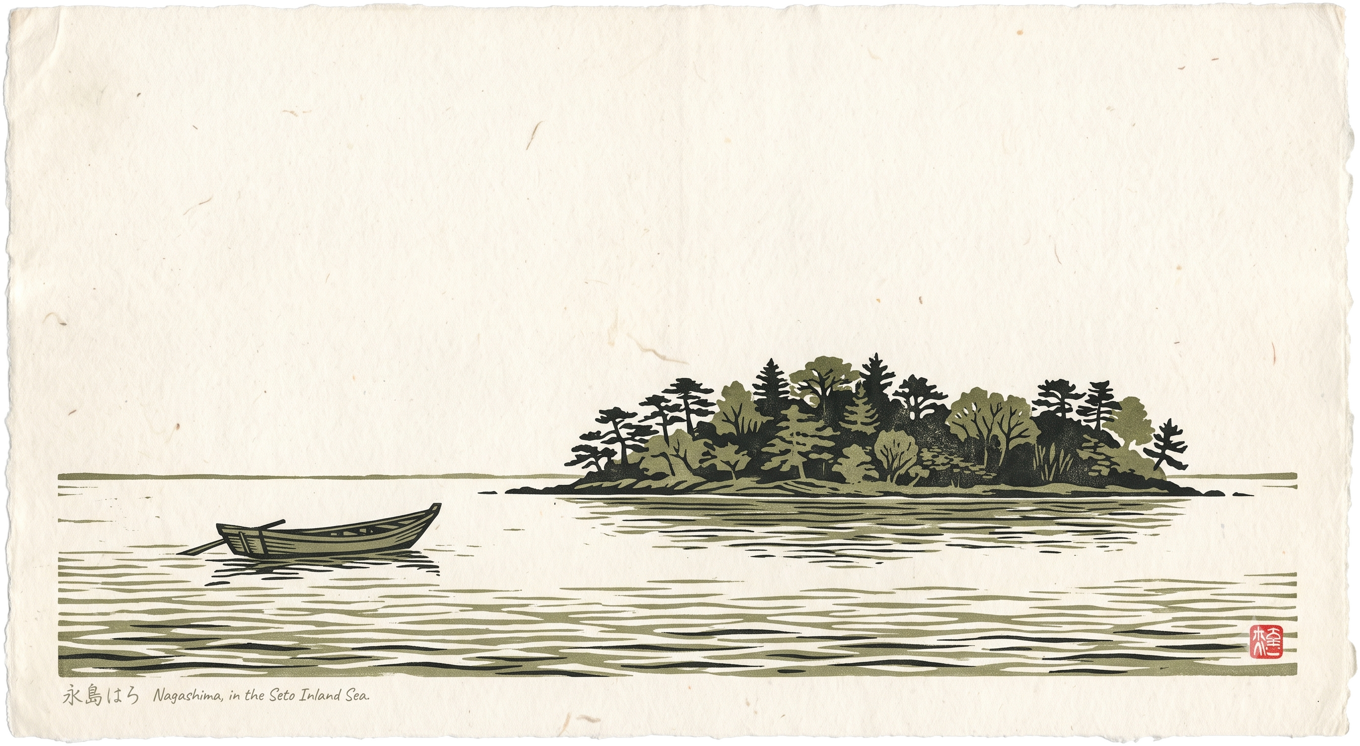
In October of 1942, a young woman named Mieko Kamiya took a boat to a small island in Japan's Seto Inland Sea. She stayed twelve days.
The island was Nagashima. On it stood Nagashima Aiseien, a sanatorium where people with leprosy were confined, by law, apart from the rest of Japanese society. Kamiya wasn't yet a psychiatrist. She was a linguist's daughter with an unusual education and an unfinished sense of what she was for.
Those twelve days stayed with her. She came back as a doctor fifteen years later, and by 1965 she was the sanatorium's chief psychiatrist. Somewhere in the thousands of hours of conversation that followed, she noticed something she couldn't explain.
The patients with the most severe symptoms weren't, as a rule, the ones in the deepest despair. It was often the patients with the lightest symptoms who suffered most. They had the most life left in front of them and the least idea what to do with it.
That observation became the question she spent the rest of her career on. In 1966 she published Ikigai ni Tsuite, usually translated as On the Meaning of Life. It's the founding text on the subject, and almost no one in the English-speaking world has read it.
What we got instead was a diagram.
Where the ikigai Venn diagram actually came from
You've seen it. Four overlapping circles. What you love. What you are good at. What the world needs. What you can be paid for. At the center, in the small petal where all four meet, one word: ikigai.
It's one of the most reproduced images in modern self-improvement, and it isn't Japanese.
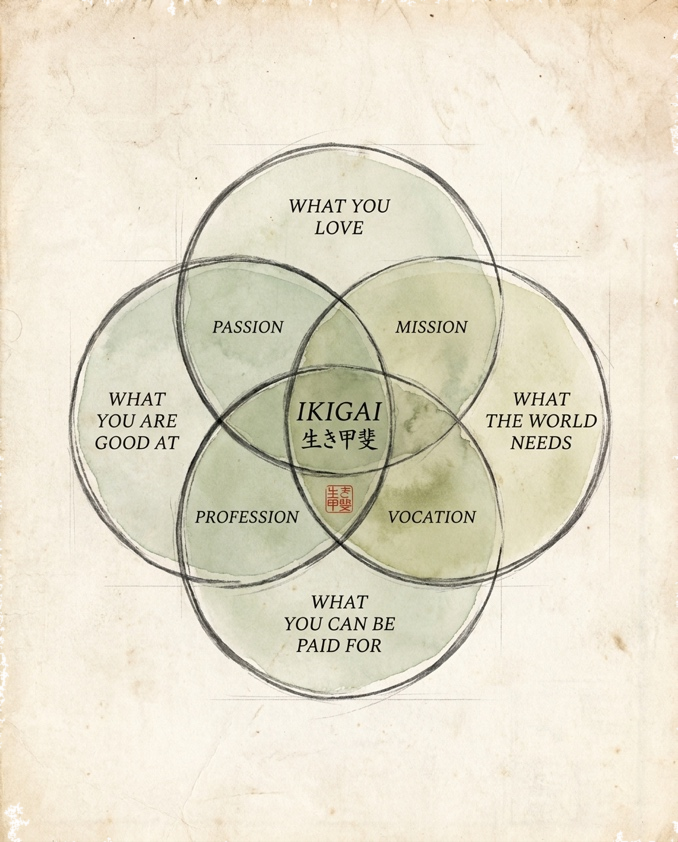
A Spanish astrologer and writer named Andrés Zuzunaga drew it in 2011. In his version the word at the center was propósito. Purpose. A Western career-and-calling framework, and a reasonably elegant one.
Three years later a British entrepreneur named Marc Winn came across it. He'd also encountered the word ikigai through Dan Buettner's work on the Blue Zones, the long-lived populations of the world, one of which is Okinawa. Winn put the two together in a blog post. He swapped one word at the center of someone else's diagram and pressed publish.
That's the whole origin story. A word substitution in a blog post, now printed on office walls in forty languages.
Why we should be gentle about this
There's a whole genre of article that exists to tell you the ikigai diagram is a fraud. That isn't what this is.
The diagram spread because it was useful. It gave millions of people a vocabulary for a restlessness they couldn't otherwise name. Something that does that much work has earned its place.
But a doorway isn't a house. If you've ever stared at that little center petal and felt a quiet sense of failure because your four circles refuse to overlap, the problem was never you. The diagram is answering a question Kamiya wasn't asking.
What ikigai actually means in Japanese
Iki is life, or to live. Gai comes from kai, meaning worth or value. Ikigai is, roughly, the thing that makes life feel worth living.
Ask a person in Japan about their ikigai and you're unlikely to hear about career alignment. You're more likely to hear about a grandchild. A vegetable garden. A morning walk along one particular stretch of road. The neuroscientist Ken Mogi, who has written extensively on the subject for Western readers, describes ikigai as something available in small things and in the present moment.
Three things follow, and they matter more than they first appear.
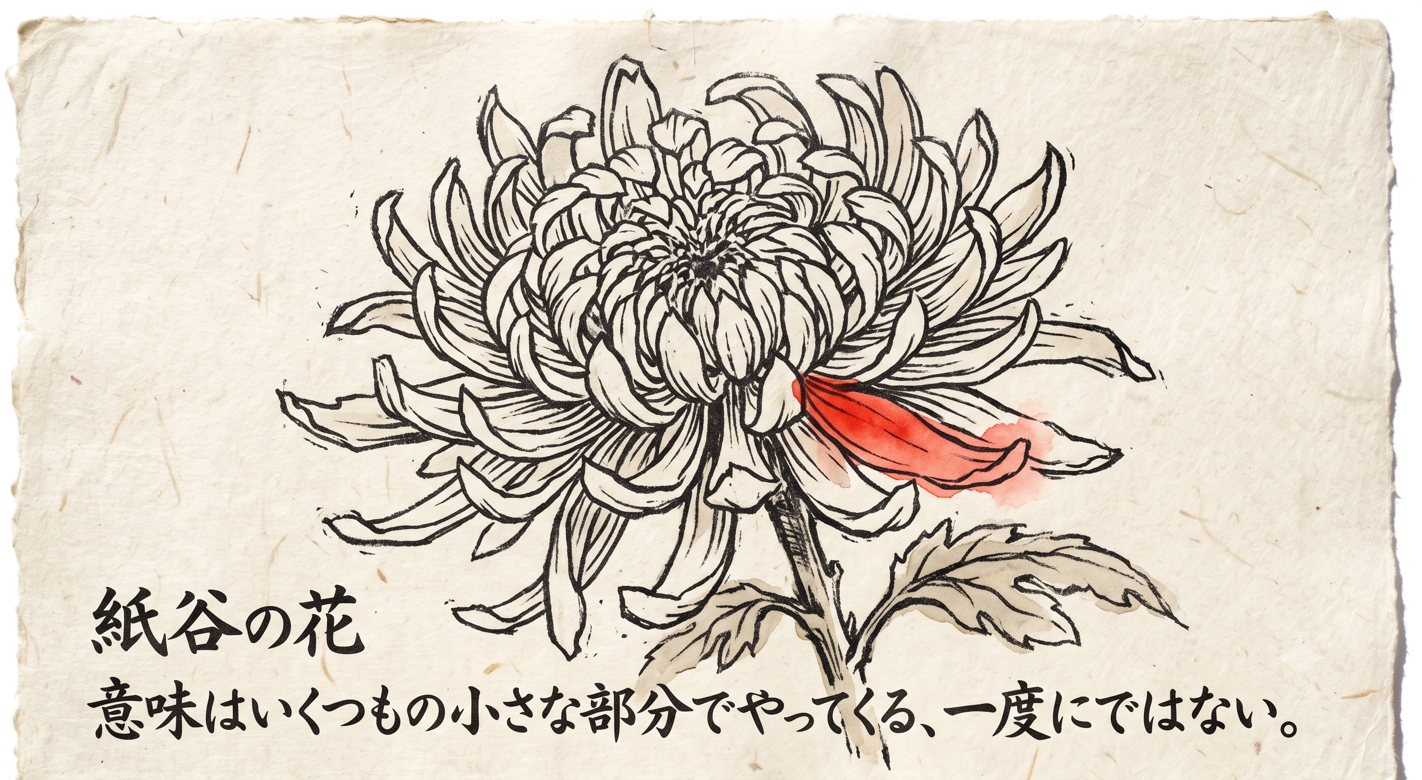
Ikigai is usually plural. Kamiya's framework is often drawn as a flower with many petals, each one a different source of meaning. Not a single calling. Several small anchors held at once, so that losing any one of them doesn't bring the whole structure down.
Ikigai doesn't have to pay. The insistence that your reason for living must also generate income is the most Western thing about the four-circle diagram. Remove that circle and a great deal of pressure leaves the room. Your ikigai is allowed to be the thing you do on Saturday morning, badly, for free.
Ikigai is noticed more often than it's found. This one is hard, because the whole architecture of self-improvement rests on the verb find. Kamiya's patients weren't searching a field of options. They were trying to see what was already in front of them clearly enough to feel its weight.
What the research actually shows
The claims made for ikigai online tend to outrun the evidence, so it's worth being precise.
The best-known study is the Ohsaki Study, published in Psychosomatic Medicine in 2008. Researchers asked 43,391 Japanese adults a single question, essentially: do you have ikigai in your life? Then they followed them for seven years.
The people who said yes were less likely to die during the study period. The association was clearest for cardiovascular deaths and for deaths from accident and suicide. Cancer mortality showed almost no relationship at all.
This is an association, not proof of cause. Feeling that life is worth living and being in good health travel together, and untangling which one pulls the other is genuinely difficult. But the finding has held up across enough follow-up work to be taken seriously.
Notice what the study didn't ask. Whether the participants were doing what they loved. Whether the world needed it. Whether anyone was paying. One plain question, and the answer predicted seven years of outcomes.
The question that replaces the diagram
Kamiya's real question, the one she carried off that island, was closer to this: what makes a person feel their life is worth living, even when the circumstances of that life cannot be changed?
That reframing does something the diagram can't. It works for the person who isn't going to change careers. For the person caring for a parent. For the person working a job they took for reasons that were sound at the time. Which is to say it works for most people, most of the time.
The practice that follows isn't a brainstorm. It's closer to attention. You aren't generating a list of possible lives. You're learning to notice which ordinary hours in your existing life are quietly holding weight, and giving those hours a little more room.
The tree that is never finished
A bonsai isn't designed and then executed. It's shaped over years by someone who cuts a little, waits, sees what the tree does, and cuts again. The grower isn't imposing a vision so much as staying in conversation with something already alive. Nothing about it can be accelerated, and the work is never actually complete. That's the practice, not a flaw in it.
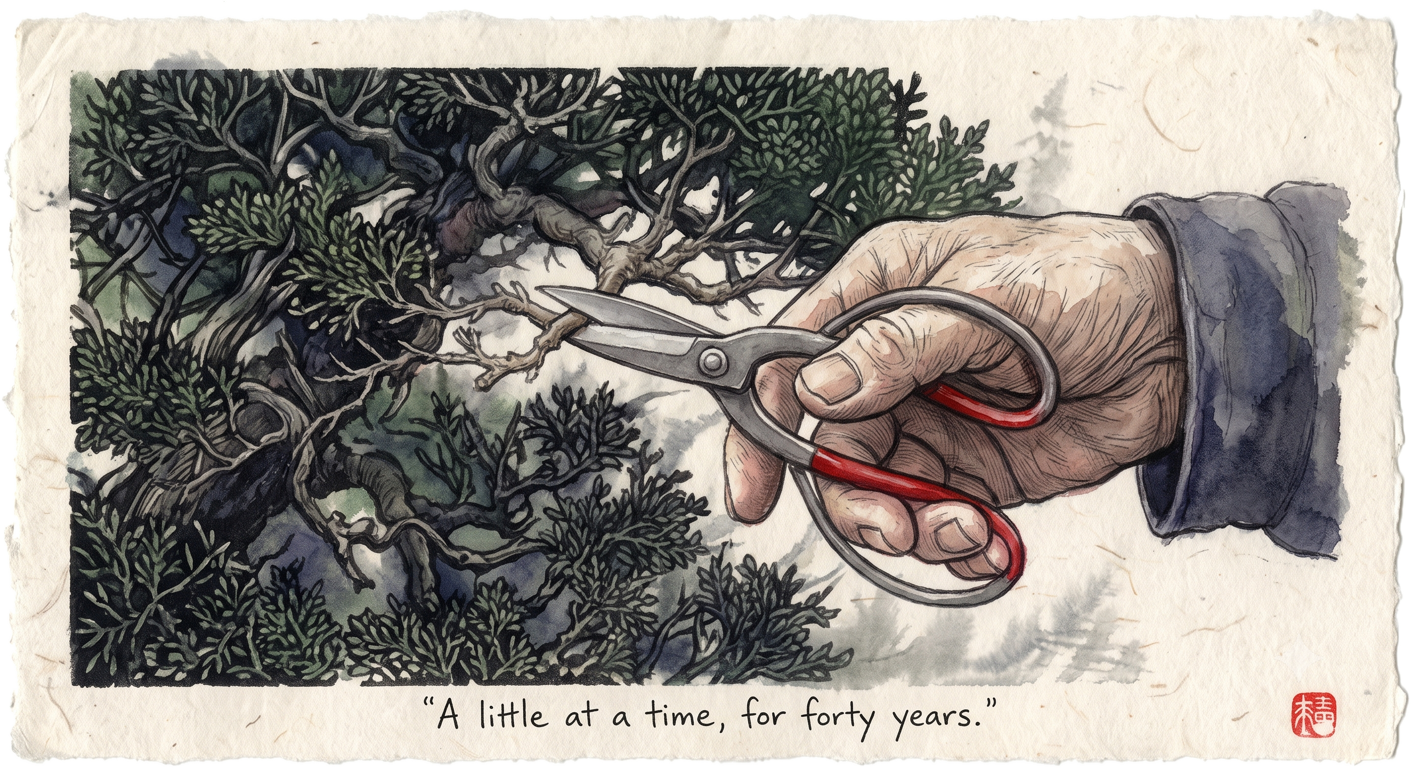
Ikigai works the same way. You won't solve it on a Sunday afternoon with four circles and a pen. You'll notice something small, give it slightly more room next week than it had last week, and find, some years later, that the shape of your days has changed without any single dramatic decision having been made.
Sources and further reading
- Kamiya, Mieko. Ikigai ni Tsuite (On the Meaning of Life), 1966.
- Sone, T. et al. “Sense of Life Worth Living (Ikigai) and Mortality in Japan: Ohsaki Study.” Psychosomatic Medicine, 70(6), 2008.
- Mogi, Ken. The Little Book of Ikigai.
- Ikigai Tribe, “Ikigai Misunderstood and the Origin of the Ikigai Venn Diagram.”
“Fall seven times, stand up eight.”
七転び八起き · Japanese proverb