
Kintsugi Does Not Mean Broken Things Are Beautiful
Kintsugi is usually explained as finding beauty in what is broken. The actual craft says something harder and more useful about repair, and about how long it takes.
Sometime in the late fifteenth century, a tea bowl belonging to the shogun Ashikaga Yoshimasa cracked.
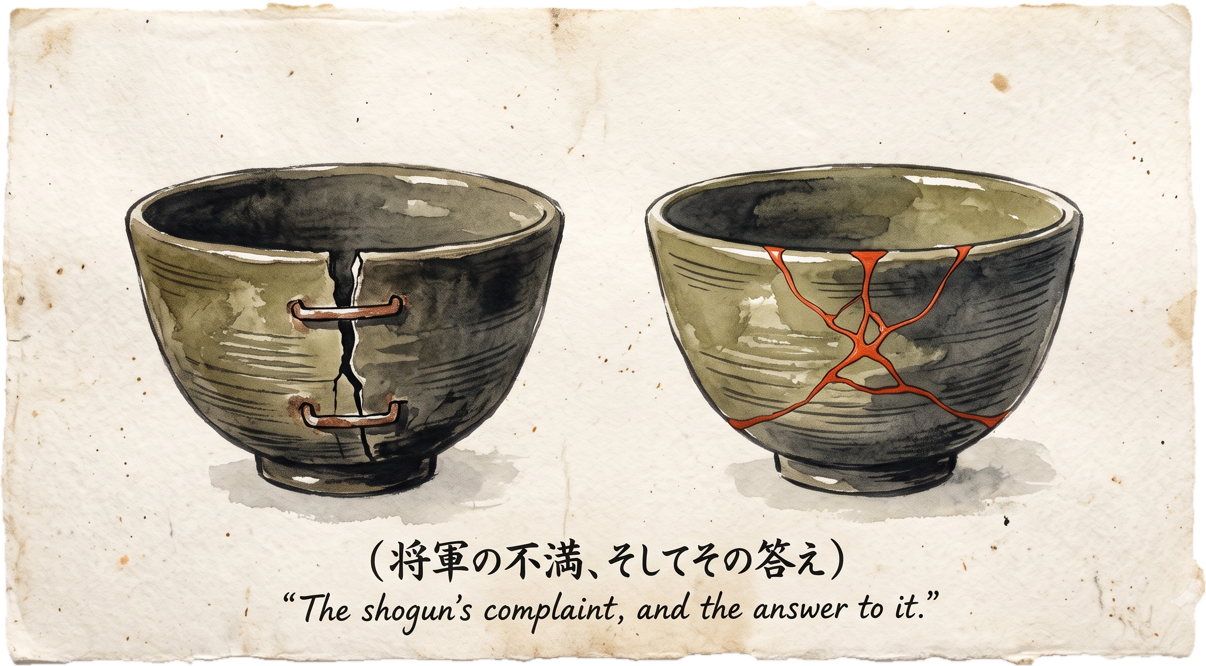
It was a valuable bowl, and Yoshimasa did what a person of his position would do. He sent it back to China, where it had been made, to be repaired. In due course it came home, mended with metal staples driven across the break.
He hated it.
The bowl worked. It held tea. But the repair announced itself as damage control, a piece of hardware bolted across a failure, and every time he looked at it he saw the accident instead of the object. So Yoshimasa asked his own craftsmen whether there was a better way.
What they arrived at was kintsugi, golden joinery. The broken edges are joined with urushi, a lacquer made from tree sap, and the seams are then dusted with powdered gold. Nothing is hidden. The repair is illuminated. The bowl comes back with a map of its own breaking running across it in gold.
That's the story, at least as it's usually told. And it's become, over the last decade or so, one of the most borrowed metaphors in the English-speaking world.
What the metaphor usually gets turned into
You know the version. You are not broken, you are golden where you broke. It turns up on prints, in captions, in the closing paragraph of a great many articles about resilience.
There's something true in it. But the way it gets deployed skips the part that actually matters, and in skipping it, does a small quiet harm.
The short version implies that breaking is good. That the crack itself is the beautiful thing. That having been damaged is, in some direct way, an upgrade.
The craft says something different and harder. A break is a break. What makes it beautiful afterward is the labor of the repair.
That distinction isn't academic. If the break is the beautiful part, then a person in the middle of one is failing to appreciate their own good fortune. If the repair is the beautiful part, then a person in the middle of a break is simply not finished yet, and the work in front of them is real work.
The part nobody mentions: it is slow
Almost every article about kintsugi describes gold. Almost none describe urushi.
Urushi is the sap of the lacquer tree, and it's difficult material. It causes a severe rash on contact with bare skin for most people. It doesn't dry the way glue dries, either. It cures, and it cures only in warm, humid conditions, in a controlled cabinet, over days. A traditional kintsugi repair gets built up in thin layers, each one applied, cured, and smoothed before the next can go on.
A single bowl, done properly, takes weeks. Complicated pieces take months.
The gold arrives at the very end. It's the last thin dusting on top of a structure built slowly and invisibly underneath, and it accounts for almost none of the work.
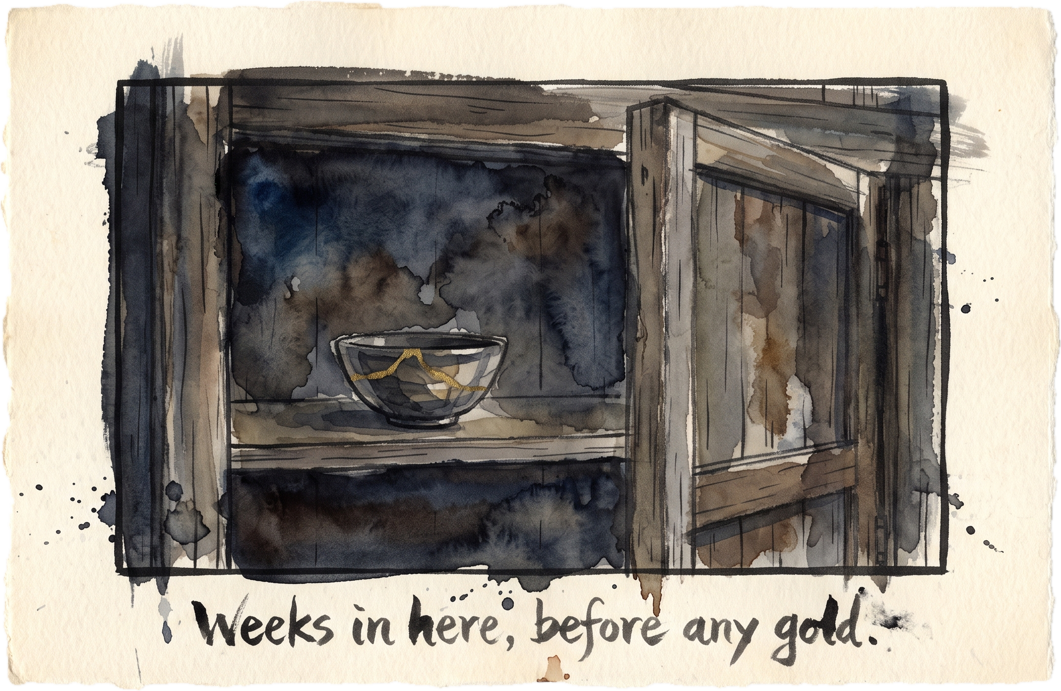
Sit with that against the way the metaphor usually gets used. What we took from kintsugi is the gold, which is the fastest and least demanding part of the whole process. We left behind the months of curing, which is the part that would have told us something.
What the research says about growth after damage
The psychological version of this has a name and a literature.
In the 1990s two researchers at the University of North Carolina at Charlotte, Richard Tedeschi and Lawrence Calhoun, began studying people who'd come through severe adversity, and coined the term post-traumatic growth for a pattern they kept encountering. Their inventory measures reported change across five domains: a greater appreciation of life, warmer and closer relationships, a sense of new possibilities, an increased sense of personal strength, and spiritual or existential change.
Hundreds of studies have followed. Three qualifications get lost when the finding travels, and they matter enormously.
Growth isn't universal. Plenty of people who go through severe adversity never report it, and presenting it as the expected outcome sets up a second failure for people already carrying a first one.
Growth and distress coexist. Post-traumatic growth isn't the point at which suffering ends. People commonly report both at once, sometimes for years. A gold seam is still a seam.
And the growth comes from the struggle rather than the event. This is Tedeschi and Calhoun's own framing and it's the crux of the whole thing. Trauma doesn't produce growth. What produces growth, sometimes, is the effortful and extended work of rebuilding a worldview that the trauma broke. Nobody grows from being dropped. People grow from the months of putting it back together.
Which is, almost exactly, urushi.
What to do with this
Three things follow, and none of them are consoling in the way the print on the wall is consoling.
Don't rush to find the meaning. A break that happened last month doesn't owe you a lesson yet. The urushi hasn't cured. The instinct to extract significance immediately is usually an attempt to stop feeling the thing, and it tends to produce a brittle repair that opens again later.
Do the invisible layers. Whatever your version of them happens to be: the boring, repetitive, unglamorous work of reconstructing an ordinary life. Sleep. Meals. Turning up to things. This is the part with no gold on it and it's the part that holds.
Let it show, eventually. The final move in kintsugi is refusing to pretend the break didn't happen. Not performing it, not leading with it, just declining to sand it smooth. Most people go the other way and spend years maintaining a surface that costs more to hold than the seam ever would have.
The scar the grower leaves in
There's a technique in bonsai called jin, where a branch is stripped of its bark and left as bare, bleached deadwood on a living tree. A related one, shari, deliberately exposes a strip of the trunk.
To an untrained eye these look like injuries the tree failed to recover from. In practice they're among the most carefully considered elements of a mature specimen. They're what tells you the tree has been somewhere. A trunk with no history in it reads as young, and a little empty, no matter how well shaped it is.
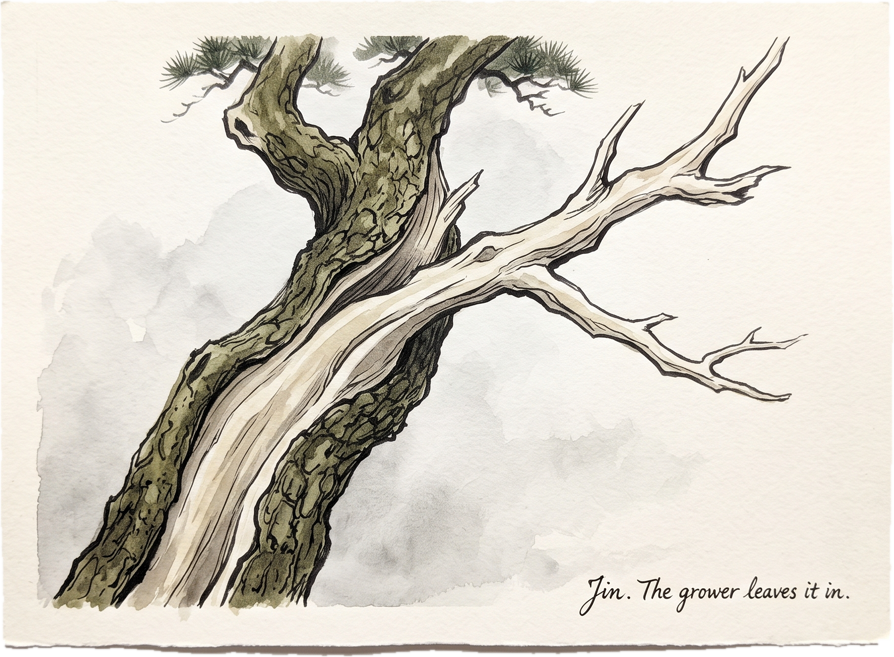
The grower doesn't hide the deadwood, and doesn't celebrate it either. It's simply allowed to remain, part of the record, while the living part of the tree goes on growing around it for another eighty years.
Sources and further reading
- Tedeschi, R. G. and Calhoun, L. G. Research on post-traumatic growth and the Post-Traumatic Growth Inventory, University of North Carolina at Charlotte.
- Britannica, “Kintsugi | History, Pottery, & Facts.”
- Traditional Kyoto, “Kintsugi: Art of Repair.”
“Fall seven times, stand up eight.”
七転び八起き · Japanese proverb