
Wabi-Sabi and the Quiet End of Perfectionism
Wabi-sabi is usually translated as the beauty of imperfection. That translation is doing it a disservice. Here is what the Japanese aesthetic actually asks of a perfectionist.
There's a story about Sen no Rikyū, the sixteenth-century tea master who shaped the Japanese tea ceremony into the form it still holds, and it gets told slightly differently every time.
In most versions Rikyū is asked to prepare a garden. He works at it for hours. He sweeps the path, rakes the moss, clears every fallen leaf until the ground is immaculate. Then, standing back to look at what he's made, he walks to a cherry tree at the edge of the garden and shakes it, so that a scattering of blossoms falls across the swept ground.
Only then does he call his teacher to come and look.
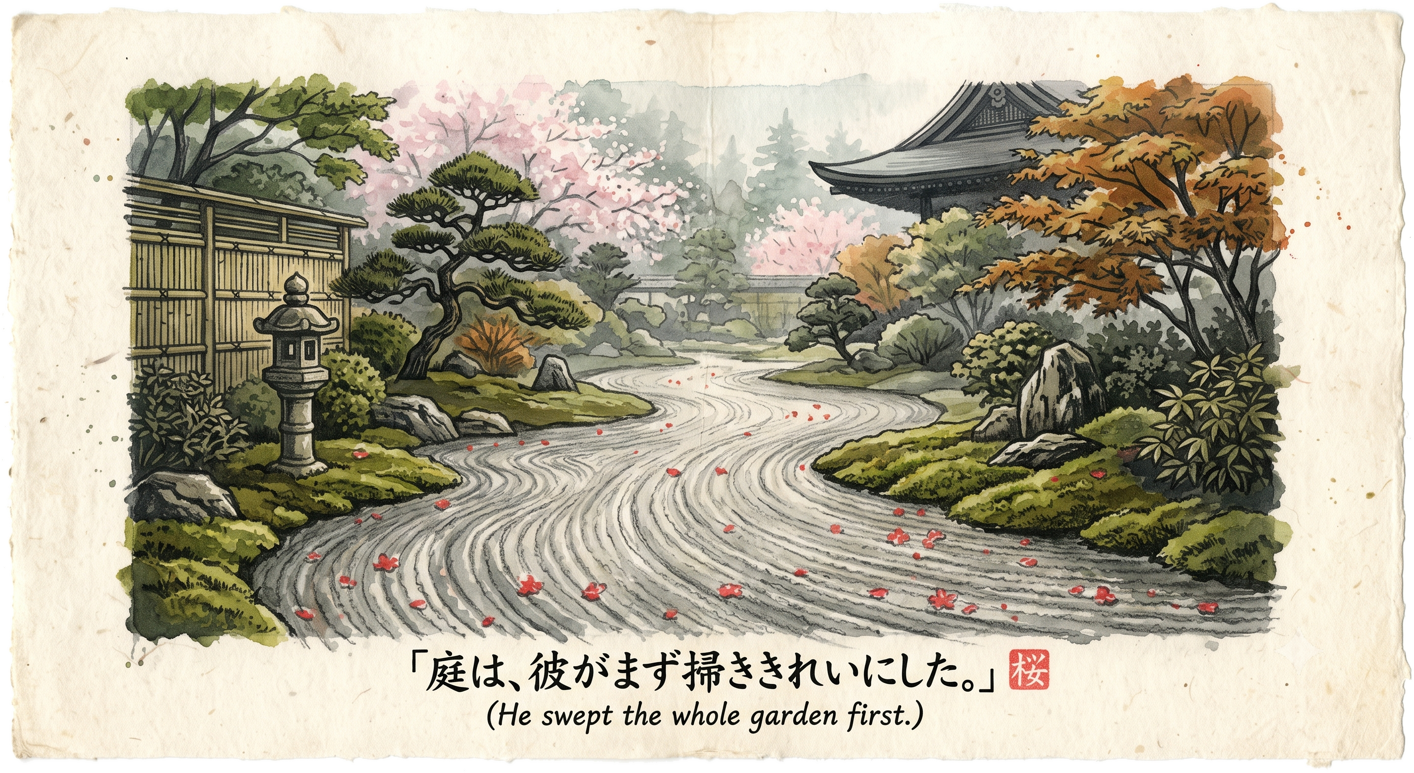
The story has been polished by centuries of retelling. It survives because it holds something a definition can't. Rikyū didn't skip the sweeping. He swept everything. The blossoms only mean what they mean because the ground beneath them was perfect first.
That distinction is the whole of wabi-sabi, and it's the part almost every English-language explanation leaves out.
What wabi-sabi actually means
The term joins two older words that spent centuries drifting toward each other.
Wabi originally carried something close to loneliness, the bleakness of living apart from the world. Over time, and largely through the tea masters, it turned. It came to mean a rustic simplicity, a contentment found in modesty and in what's unadorned.
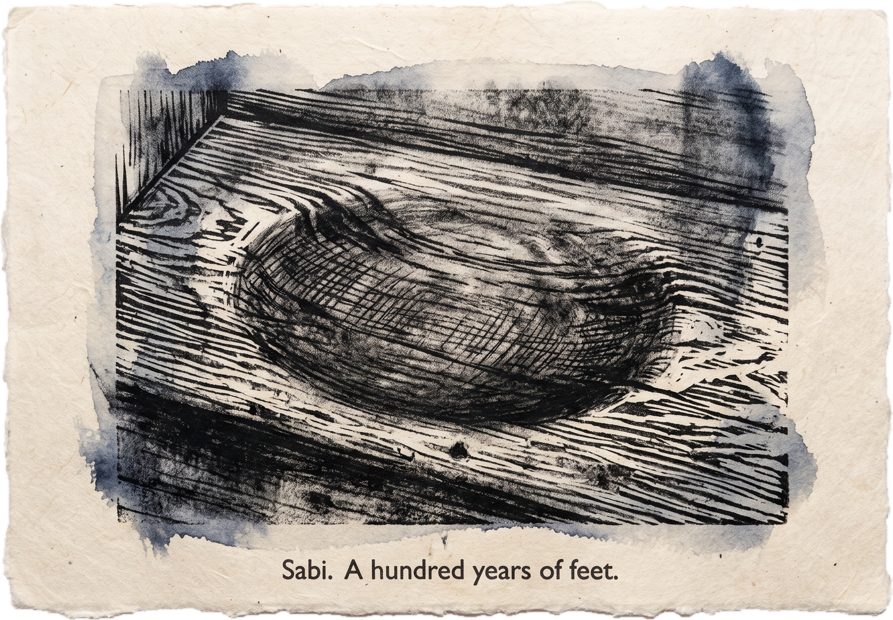
Sabi meant something nearer to chill, or withering, or lean. It softened too, into the particular beauty that arrives only with age and use. The patina on a bronze handle. The worn place on a wooden stair where a hundred years of feet have gone.
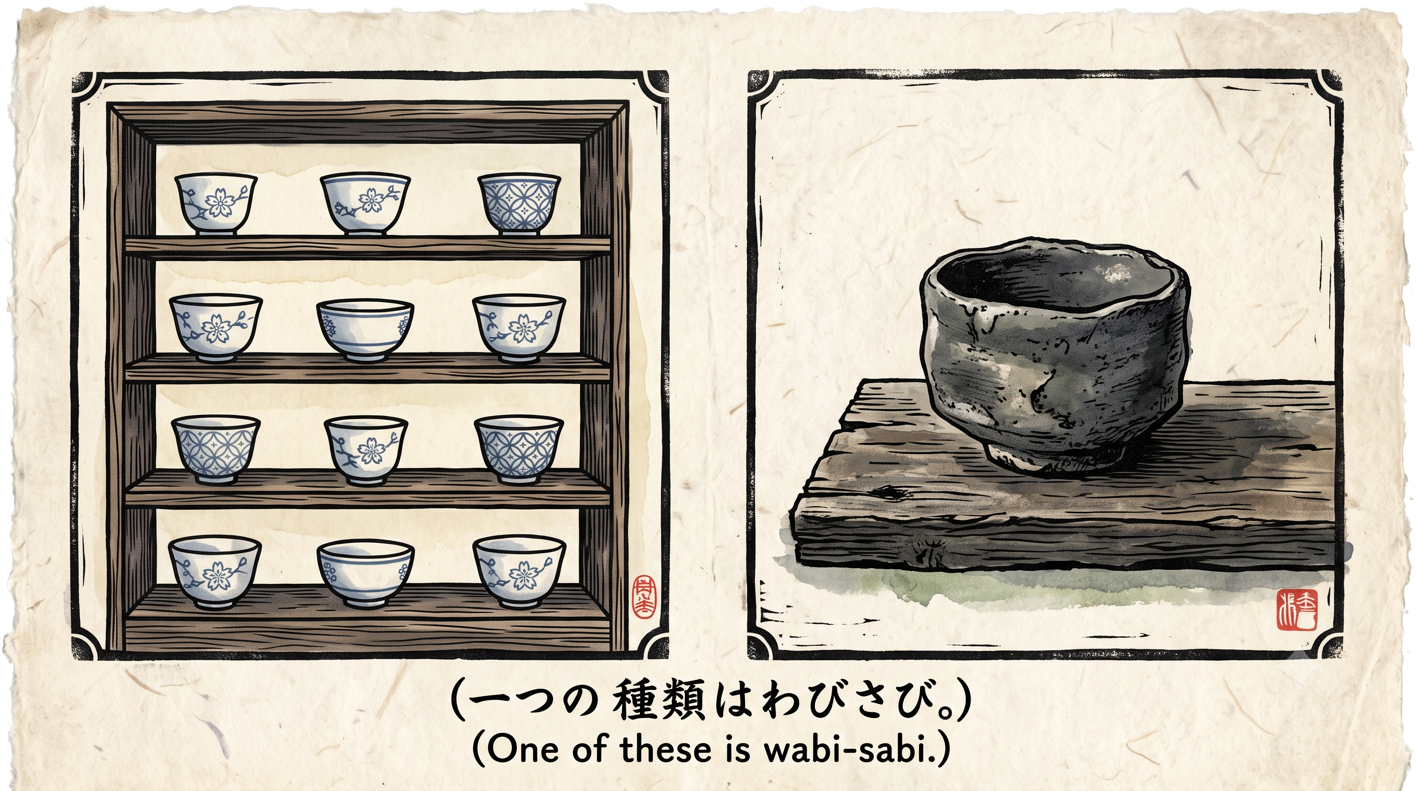
Together they describe a sensibility that finds beauty in things that are imperfect, impermanent, and incomplete. It comes out of Zen Buddhist thought, and it was refined through the tea ceremony, where a rough, slightly misshapen bowl made by an unknown potter came to be valued above a flawless imported one.
The American writer Leonard Koren did more than anyone to carry the idea into English, in a slim 1994 book aimed at artists and designers. He was careful to separate the form of wabi-sabi from its spirit. That turned out to be prescient. The form is what got exported. The spirit mostly stayed home.
The version that got exported
Search wabi-sabi today and you'll mostly find an interior design style. Linen. Undyed wood. Handmade ceramics, expensively acquired. A palette of oatmeal and clay.
None of it is wrong exactly. But there's something odd about a philosophy of accepting imperfection being turned into a set of things you have to buy, arrange correctly, and photograph well. Perfectionism has simply changed clothes.
The second distortion is gentler and does more damage. It's the reading of wabi-sabi as permission to lower the bar. Nothing has to be perfect, so relax. This sounds kind. In practice it tends to make people feel worse, because most perfectionists don't actually want lower standards. They want to stop being punished by their own.
Rikyū swept the whole garden. Wabi-sabi is about what you do with the last five percent.
Why this matters more now than it did in 1994
The most careful piece of research here is a meta-analysis by Thomas Curran and Andrew Hill, published in Psychological Bulletin. They gathered data from 164 samples of American, Canadian, and British college students, 41,641 people in total, who'd completed the same standard perfectionism scale between the late 1980s and 2016.
The scale measures three distinct things. Self-oriented perfectionism, meaning the demand you place on yourself. Other-oriented perfectionism, the demands you place on everyone else. And socially prescribed perfectionism, the sense that other people are demanding perfection from you.
All three rose over those twenty-seven years. Self-oriented went up by about ten percent, other-oriented by about sixteen. Socially prescribed perfectionism, the feeling of being watched and measured and found wanting, rose by roughly thirty-three percent.
That's the one that hurts. It's also the one a metrics-saturated, permanently visible culture is best equipped to manufacture. Curran and Hill point at competitive individualism, at the way a person's worth has come to be treated as something continuously assessed and ranked.
The condition wabi-sabi speaks to, in other words, isn't a niche aesthetic preference. It's close to the defining psychological weather of the last three decades.
What wabi-sabi actually asks of you
Three shifts, none of them fast.
The first is to finish things at ninety-five percent, deliberately. Not out of laziness, and not because the last five percent is worthless, but because you've decided the object is allowed to bear a mark of the hand that made it. Several traditional crafts include the practice of leaving one small intentional flaw. The reason isn't humility for its own sake. A thing with no evidence of its making has nothing to say about anyone.
The second is to stop treating age as damage. The scratched table, the worn jacket, the face in the mirror that's been doing this for a while now. A culture selling you restoration at every turn has a financial interest in your reading wear as loss. Sabi offers the counter-proposal: some things only become themselves after years of use, and you can't skip ahead to that state by buying a distressed version of it.
The third is the useful practical distinction hiding inside the Curran and Hill data. Caring how your work turns out was never the problem. The problem is the imagined audience assessing you while you do it. Wabi-sabi asks you to keep the standards and work without the gallery.
The unfinished tree
A bonsai is never finished. That's horticulture, not poetry.
The tree keeps growing. The grower keeps returning. A bonsai that's been in a family for two hundred years isn't two hundred years complete, it's two hundred years underway, and everyone who has held it left decisions in it that the next person inherits and works around.
If you've ever stood in front of a very old specimen, you'll have noticed that the marks of its history are the most interesting thing about it. The deadwood. The scar where a major branch came off decades ago and the tree grew around the wound. Growers don't conceal any of it. Quite often it's the reason the tree is valued at all.
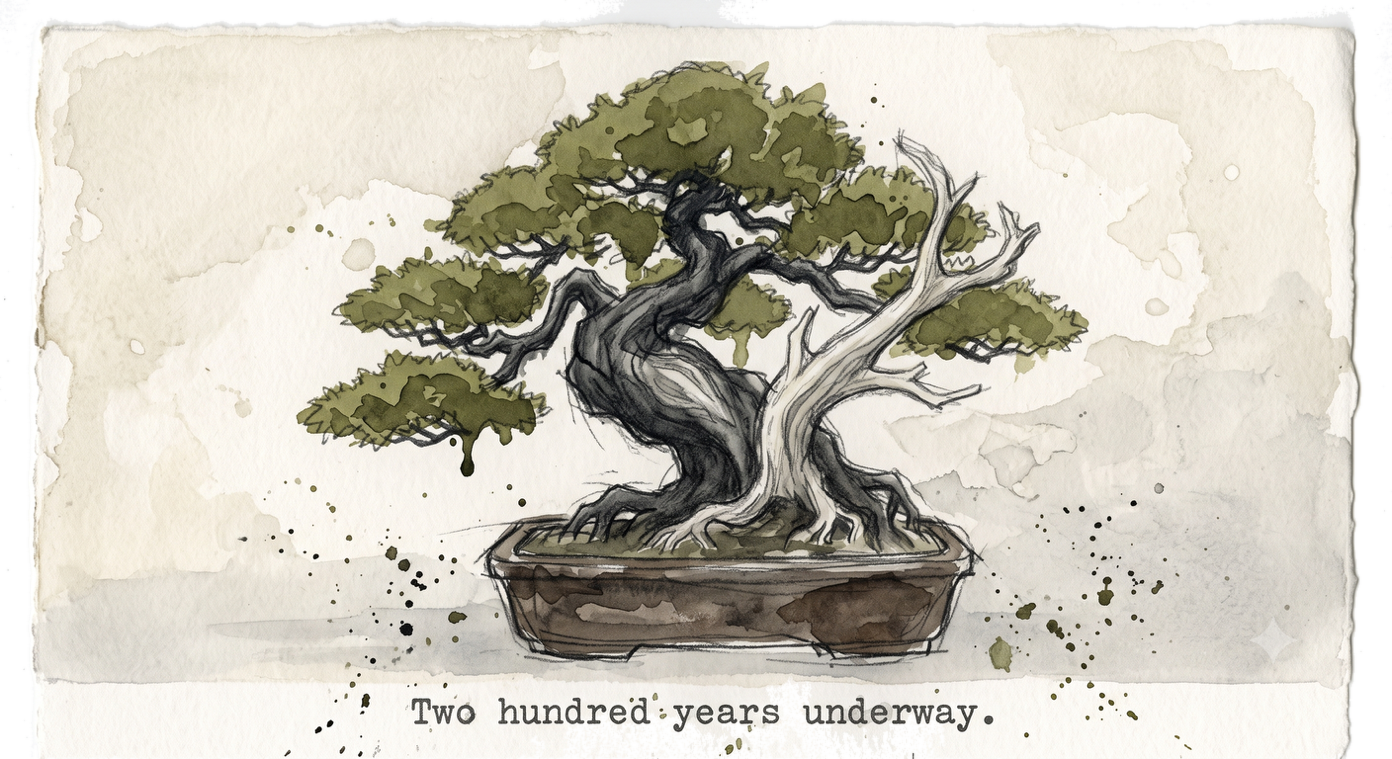
The record the tree carries is the reason it's beautiful. That took a hundred years to say, and it can't be said any faster.
Sources and further reading
- Curran, T. and Hill, A. P. “Perfectionism Is Increasing Over Time: A Meta-Analysis of Birth Cohort Differences From 1989 to 2016.” Psychological Bulletin, 2019.
- Koren, Leonard. Wabi-Sabi for Artists, Designers, Poets & Philosophers, 1994.
- Kempton, Beth. Wabi Sabi: Japanese Wisdom for a Perfectly Imperfect Life.
“Fall seven times, stand up eight.”
七転び八起き · Japanese proverb